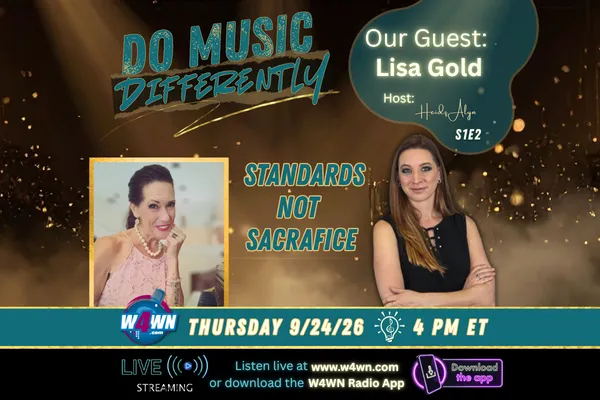
Standards Not Sacrafice
Do You Have to Lower Your Standards to Make It in Music?
Do Music Differently — Season 1, Episode 2
Guest: Lisa Eva Gold
Do you have to sacrifice stability, time, money, or even parts of yourself if you want to succeed in music?
That was one of the questions I explored with musician, music teacher, composer, and radio host Lisa Eva Gold on this episode of Do Music Differently.
Lisa grew up hearing some familiar warnings about pursuing music professionally. Musicians don't make money. The industry isn't always safe. People can be crude. Get a “real” job instead.
Her parents wanted her to have stability, and those messages helped shape an old rule about what pursuing music might require:
OLD RULE: To succeed in the music industry, you have to lower your standards and make sacrifices.
But our conversation went much deeper than that one rule.
We talked about the different directions Lisa's life has taken, what those experiences taught her, different ways of thinking about practice and performance, and what can happen when you stop looking at your path as a collection of wrong turns.
Watch Here
Maybe You Aren't Scattered
One of my favorite parts of our conversation was Lisa's story about being told that all of the different things she has done weren't evidence that she was “scattered.”
There was a synergy between them.
Lisa's path has included music, teaching, acting, mentoring, medical work, composing, radio and more. On the surface, those could look like unrelated directions.
But what if they aren't?
Lisa compared it to a quilt. Different patterns and pieces come together to create something that wouldn't exist without each individual part.
That really resonated with me.
Before returning to music, I worked in retail, managed stores, marketed products, created displays and learned management skills. For a long time, those jobs could have looked like time spent away from becoming the rock star I wanted to be.
Eventually I realized I had been developing skills I could use in music the entire time.
Marketing a store taught me about marketing a band. Creating displays taught me about presentation. Management taught me how to organize people and projects.
The experience wasn't wasted. It was part of the path.
That made me wonder how many music professionals are discounting skills and experiences that could actually become part of their advantage.
You Don't Have to Do More for It to Count
Our conversation also took an interesting turn when we started talking about practice.
Musicians can put enormous pressure on themselves about what “real” practice is supposed to look like.
Maybe you think you should practice for hours every day. When life doesn't allow for that, it can feel like you're not doing enough.
Lisa offered a different perspective.
You don't necessarily have to be sitting at your instrument to practice.
She talked about visualizing the instrument, imagining the notes, listening to the music and mentally working through difficult sections. She also encourages students to break challenging pieces into smaller sections instead of trying to conquer everything at once.
Sometimes ten focused minutes can move you forward.
That led us to another rule worth questioning:
Does progress have to be difficult or time-consuming for it to count?
Remember Why You're on the Stage
We also talked about performance anxiety.
Lisa shared advice that stuck with me: when you're anxious onstage, remind yourself why you're there instead of focusing only on how you're feeling.
I know that feeling.
There are times when I step onto a stage and my first internal reaction is basically, What are you doing here? Why did you think this was a good idea?
Then the music starts.
And I remember.
This is why I'm here.
Lisa has developed her own way of moving through that feeling. She imagines herself putting on the “cloak” of the musician. Her experience with acting and performance has helped her step into that part of herself when nervousness shows up.
She also talked about something even bigger than performing: learning to use her voice.
Lisa described herself as extremely shy when she was younger. Through music, acting, teachers, mentors and life experience, she began recognizing that she had something worth sharing.
You're here. Speak up. People want to hear what you have to say.
Know the Rules So You Can Rewrite Them
Toward the end of our conversation, Lisa said something that couldn't have fit Do Music Differently better:
When you know the rules, you know how to break them.
That doesn't mean ignoring everything the music industry has taught us.
Learn the rules.
Understand why they exist.
Then decide whether they still work for you.
Lisa's career doesn't look like one straight line toward one traditional definition of music industry success.
She teaches. She performs. She composes. She mentors. And she hosts The Sound of Gold, where she highlights musicians, venues, teachers, schools, composers and others throughout the music community.
All of those pieces can belong.
So, Do You Have to Lower Your Standards?
Our conversation started with the idea that pursuing music may require lowering your standards or accepting sacrifices simply because “that's how the industry works.”
We ended somewhere very different.
You don't have to dismiss the experiences you've had outside music.
You don't have to follow one prescribed path.
You don't have to measure your progress by someone else's definition of what a serious musician should be doing.
And you don't have to become Billy Joel or Elton John before your music has value.
As Lisa pointed out during our conversation, just because you don't have their name doesn't mean you don't have a name.
Your experiences, skills, interests, relationships, challenges and even the detours you've taken can become part of what makes your music career uniquely yours.
NEW RULE: The music industry is changing. There are opportunities on many levels. You can find the people, opportunities and path that allow you to make music without lowering your standards.
Watch the Full Conversation
There was much more to my conversation with Lisa than I could fit into one blog post.
If something here made you think about your own path differently, watch the full episode of Do Music Differently to hear Lisa's stories and the complete conversation behind these ideas.
To get the most out of what you listened to ask yourself:
What experiences have I been treating as detours that could actually be an advantage?
What standards am I unwilling to sacrifice?
What definition of success am I using?
And most importantly...
What rule are you ready to rewrite?
About Lisa Eva Gold
Lisa Eva Gold is a musician, music teacher, composer and radio host who has spent decades learning, performing, teaching and creating music. She hosts The Sound of Gold, a show focused on musicians, music venues, music teachers, music schools, composers and the people creating music in our communities.
Learn more about Lisa and The Sound of Gold:
https://www.thesoundofgoldpodcast.com/people/lisa-eva-gold/
Don't miss a live episode! Get the W4WN App.w4wn.com
Tell me about your rule rewrite? Book a time here.heidzalyncoaching.com/lets-chat
Subscribe as a Reclaimer and get ideas, resources and opportunities, and ways to be a part of what we are creating. heidzalyncoaching.com/reclaimers
#StandardsNotSacrifice #RewriteTheRules #DoMusicDifferently